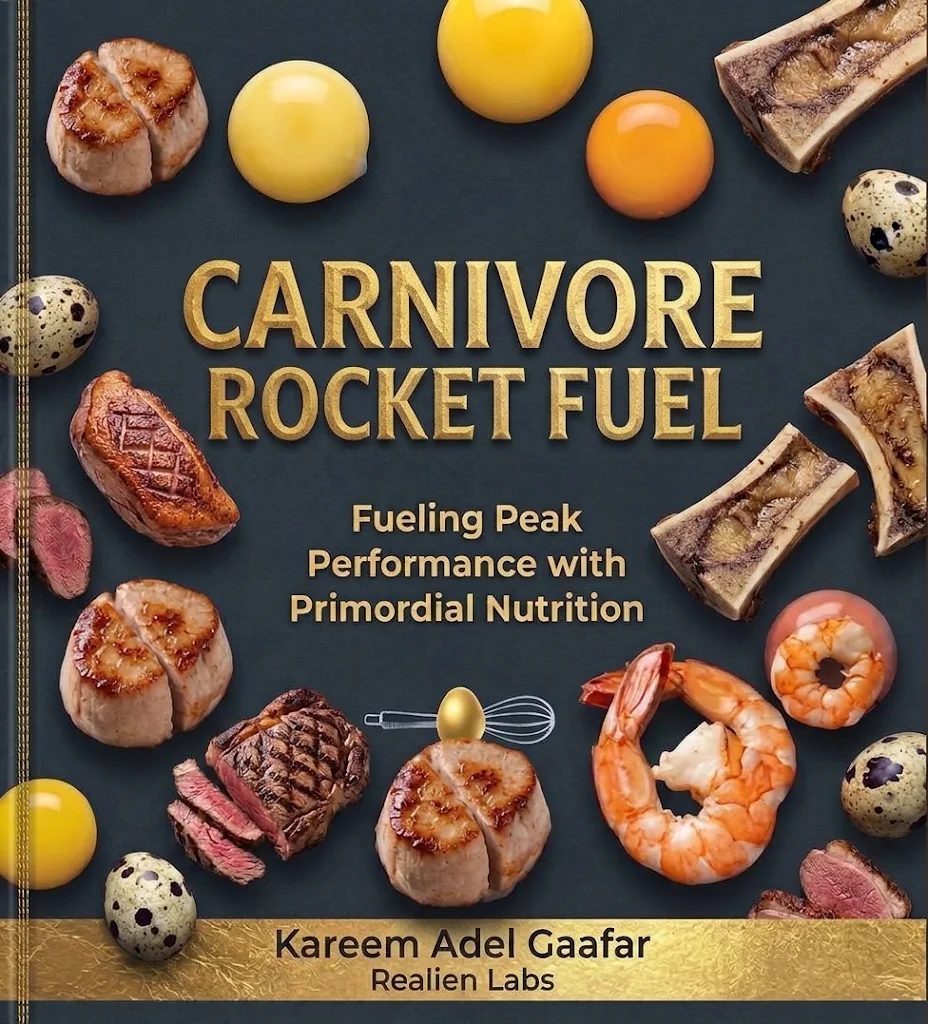
Carnivore Rocket Fuel
For informational and educational purposes only. Not professional advice. Users 21+ only.
Carnivore is a dial, not a switch. You can be as strict as you want or as permissive as you want, and this book does not ask you to pick one version and defend it. It gives you a baseline and a method for tuning that baseline to what you are trying to do: think, build, lift, recover or work at a high level for a long time. That tuning is the “rocket fuel.” Carnivore is not the answer to everything. It is a base you can adjust, measure and change for each goal.
The baseline. If you want the full benefits of a zero-carb approach, you cut the carbohydrates. On top of that, the baseline is half a pound to one pound of meat a day by raw weight, plus enough choline and micronutrients to build a real foundation, with liver and egg yolks doing much of that work. Choline shows why. The Daily Value for choline is 550 mg for adults, one hard-boiled egg has 147 mg, three ounces of pan-fried beef liver has 356 mg, and average daily intake is 402 mg in men and 278 mg in women. [1] Egg yolks are among the best sources. Two large eggs provide just over half of the Daily Value. [2] A serving of liver plus one egg comes to about 500 mg by those numbers, which is why they sit in the baseline.
Strict or permissive. Strict carnivore is one setting. Others add things back. If you want faster recovery and you have fewer concerns about longevity and fasting, you can add carbohydrate to support insulin and training. If plant matter gives you allergies or discomfort, you can keep fiber, residue and plant content low and take carbohydrate from honey, or from dairy if you tolerate it. If you do not, you find another way to bring in foods that do not cause you problems. Lower-fat cuts, tallow or coconut oil are further dials. None of these makes you “not carnivore.” They are choices about your goal.
Tuned to a goal. A founder, a lifter, someone with plant sensitivities and someone who wants lower-fat cuts will not build the same plate. The book works through each build and shows what to change and what to watch.
Brain nutrition at the lowest risk. For cognitive work and startups, the question is how to feed the brain at the lowest risk. Brain tissue is one old answer, but it carries a prion question: there is strong evidence that people can get variant Creutzfeldt-Jakob disease by eating beef products with central nervous system tissue from infected cattle, although the CDC calls the current risk extremely small. [6] Egg yolks are cheaper, easier to find and avoid that question, so they come first. Liver is the other pillar, with limits covered below.
Supplements are add-ons, and the evidence is early. The book covers lion’s mane, acetyl-L-carnitine, cordyceps and rhodiola for energy and focus, and lithium orotate. Each goes through the same test: what does the evidence actually show, in whom, and does it hold for a healthy adult chasing performance?
Lion’s mane. A 2025 systematic review of 26 studies included five randomized controlled trials, 15 laboratory studies and three pilot clinical trials, and noted possible side effects of stomach discomfort, headache and allergic reactions. [7] The human trial base is small.
Acetyl-L-carnitine. A meta-analysis of trials in mild cognitive impairment and mild Alzheimer’s disease found a significant advantage over placebo. [8] A Cochrane review of the same compound in dementia found no evidence of benefit for cognition and concluded it is unlikely to prove an important therapy. [9] Neither tested healthy people chasing peak performance.
Rhodiola and cordyceps. A systematic review of 11 trials found some evidence for physical and mental fatigue, but methodological flaws limit accurate assessment of efficacy. [10] In trials of cyclists who took rhodiola combined with cordyceps, the reported differences from placebo were not significant. [10] Another review rates the cordyceps evidence as small and mixed. [11]
Lithium orotate. One supplement review found no conclusive evidence that low-dose lithium from supplements helps, and notes that intakes from about 30 mg a day can cause side effects and affect thyroid function, while much higher intakes can cause coma or seizures. [12]
What the research says about carnivore itself. The largest dataset is a social-media survey of 2,029 adults who had eaten carnivore for a median of 14 months, 93% of them motivated by health, with a subset reporting a markedly elevated LDL cholesterol of 172 mg/dL alongside optimal HDL and triglycerides. [13] The data were self-reported, and critics point to selection bias and recall bias. [14] A smaller German survey of 24 people found LDL rising from 157 to 256 mg/dL after starting the diet. [15] A nutrient-modeling study found that carnivore meal plans fell short in thiamin, magnesium, calcium and vitamin C, with fibre significantly below recommended levels, and noted that no published study had examined the actual intakes of people on the diet. [16] A 2026 review concluded the evidence is limited, flagged the risk of deficiencies and raised LDL, and said that long-term adherence cannot be recommended at this time. [17] The book treats these findings as the reason to build carefully and measure, not as a reason to ignore the diet or to ignore the data.
Ketosis is not a universal fuel. Carnivore does not have to mean ketosis, and ketosis is not always the best fuel. In elite athletes, Louise Burke’s work found that keto-adaptation may impair the muscle’s use of glycogen, which can compromise higher-intensity exercise. [18] Her own conclusion is that there is room in sport for keto. [19] The right fuel depends on the event and on you. If ketosis feels like the worst fuel for you in a given situation, believe your own measured results over anyone’s claim that it is better.
Measure what you do. “I feel better” is a real experience, but it is hard for anyone else to check. So the book ties every change, every food and every supplement to something you can measure: a lift, a sleep score, focus blocks completed, a lab marker. The strongest evidence is a result that replicates: the same outcome in many people, in many places. One person can run a small version of that. N-of-1 designs compare conditions across periods in a single person and are a recognized way to test whether an individual responds to something. [20][21] That is how you catch a variable you would otherwise blame on the diet: a brand of fish oil that leaves you foggy might be the brand, a contaminant or you, and changing one thing at a time is how you find out which.
Safety limits, with a professional. Eating too much liver is a real risk. Vitamin A toxicity can be acute, chronic or teratogenic, and it most commonly comes from high-dose supplements or from frequent intake of vitamin A-rich foods such as liver, fish liver oils, eggs and dairy. [3] The tolerable upper limit for vitamin A is 3,000 mcg RAE per day. [4] Choline has an upper limit too: NIH lists 3,500 mg a day for adults. [5] Allergies, medications and your own lab results all change the picture, which is why the book builds a healthcare professional into the method from the start.
Peak performance, defined by you. Whether the goal is physical, cognitive, a startup or the work in front of you, the aim is the same: build the carnivore base, tune it, measure it and adjust it, so it serves your peak and not a rulebook.
The Standard of Evidence
The evidence on the carnivore diet itself is weak by design: it is surveys, a small observational study and nutrient modeling, with self-reported health and lab values and no long-term trials of hard outcomes, so the findings are shown with their limits. The cholesterol findings are included because they are among the few measured results available. The choline figures come from the NIH, and the vitamin A limits come from a clinical reference and a university extension service. The supplement evidence is early and mostly short or small, and several of the summaries come from secondary sources, such as a consumer-health site, a clinic blog, a medical-information page and a summary of a Cochrane review, so check them against the original papers before quoting them. The lithium summary comes from a preview of a paid review. The prion risk comes from a general medical-information page that cites the CDC. The sports-nutrition findings come from Louise Burke’s work, which is about elite and endurance athletes and may not apply to other goals. The baseline, the dial from strict to permissive, the goal-based builds, the egg-yolk-first approach to brain nutrition and the measure-everything method are the author’s own framework, presented as a way of thinking and not as a tested result. Nothing here is a claim that carnivore improves startup or work performance, because no study has tested that.
Sources
1. NIH Office of Dietary Supplements, “Choline: Fact Sheet for Health Professionals.” https://ods.od.nih.gov/factsheets/choline-healthprofessional/
2. GoodRx, “Foods High in Choline.” https://www.goodrx.com/well-being/diet-nutrition/foods-high-choline
3. Olson, Ameer and Goyal, “Vitamin A Toxicity,” StatPearls. https://www.ncbi.nlm.nih.gov/books/NBK532916/
4. UConn Extension, “Understanding Vitamin A: Sources, Benefits and Cautions.” https://extension.uconn.edu/?p=19810
5. NIH Office of Dietary Supplements, “Choline: Fact Sheet for Consumers.” https://ods.od.nih.gov/factsheets/choline-Consumer/?print=1
6. WebMD, “What Is Mad Cow Disease?” https://www.webmd.com/brain/mad-cow-disease-basics?page=2
7. Menon et al., “Benefits, side effects, and uses of Hericium erinaceus as a supplement: a systematic review,” Frontiers in Nutrition (2025). https://www.frontiersin.org/journals/nutrition/articles/10.3389/fnut.2025.1641246/full
8. Montgomery et al., meta-analysis of acetyl-L-carnitine versus placebo in mild cognitive impairment and mild Alzheimer’s disease (2003). https://pubmed.ncbi.nlm.nih.gov/12598816/
9. “Acetyl-L-carnitine for dementia,” Cochrane review summary via Bohrium. https://www.bohrium.com/paper-details/acetyl-l-carnitine-for-dementia/812376812377079810-7786
10. Ishaque et al., “Rhodiola rosea for physical and mental fatigue: a systematic review,” BMC Complementary and Alternative Medicine (2012). https://www.ncbi.nlm.nih.gov/pmc/articles/PMC3541197/
11. Acibadem International, “Adaptogens: The Herb Category, Sorted by Evidence.” https://acibademinternational.com/blog/adaptogens-the-herb-category-sorted-by-evidence/
12. ConsumerLab, “Lithium Supplements Review.” https://www.consumerlab.com/reviews/Lithium-Low-Dose-Supplements/lithium/
13. Lennerz, Mey, Henn and Ludwig, “Behavioral Characteristics and Self-Reported Health Status among 2029 Adults Consuming a ‘Carnivore Diet,’” Current Developments in Nutrition (2021). https://repository.lsu.edu/pbrc_basic_science_pubs/222
14. Kirwan, Mallett, Ellis and Flanagan, “Limitations of Self-reported Health Status and Metabolic Markers among Adults Consuming a ‘Carnivore Diet,’” Current Developments in Nutrition (2022). https://pmc.ncbi.nlm.nih.gov/articles/PMC9154285
15. Klement and Matzat, “Changes in Individuals From Germany Following a Self-Conceived ‘Carnivore Diet’: An Explorative Study,” Cureus (2025). https://assets.cureus.com/uploads/original_article/pdf/354775/20250418-428965-m7dvqf.pdf
16. Goedeke, Murphy, Rush and Zinn, “Assessing the Nutrient Composition of a Carnivore Diet: A Case Study Model,” Nutrients (2024/2025). https://www.ncbi.nlm.nih.gov/pmc/articles/PMC11722875/
17. Review of the carnivore diet, Nutrients 18, 348 (2026). https://pmc.ncbi.nlm.nih.gov/articles/PMC12845189
18. Burke, “Ketogenic low-CHO, high-fat diet: the future of elite endurance sport?” The Journal of Physiology (2021). https://doi.org/10.1113/JP278928
19. NIH Record, “Does Keto Boost Sports Performance?” (Dec. 13, 2019). https://nihrecord.nih.gov/2019/12/13/does-keto-boost-sports-performance
20. Schork and Goetz, “Single-Subject Studies in Translational Nutrition Research,” Annual Review of Nutrition (2017). https://jcvi.org/node/10418
21. “N-of-1 trials and self-measurement in nutritional research,” PubMed Central. https://pmc.ncbi.nlm.nih.gov/articles/PMC7202616