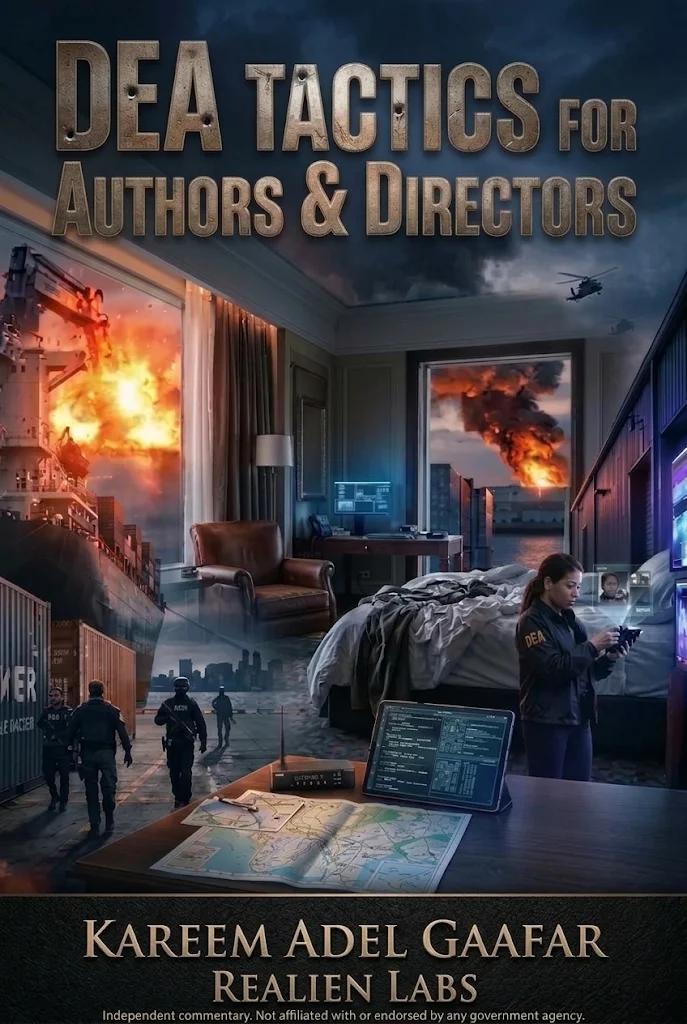
DEA tactics for Authors & Directors
For informational and educational purposes only. Not professional advice. Users 21+ only.
A realism guide for fiction writers and filmmakers, built from the public record and one firsthand account. Not legal advice.
Introduction
The Drug Enforcement Administration is one of the most written-about agencies in American fiction and one of the least accurately shown. On screen, DEA agents kick doors, chase suspects across rooftops and work alone. The public record shows something different: a federal agency that works through task forces, informants, subpoenas, court-ordered wiretaps, undercover buys and money-laundering stings, almost always beside local deputies and officers.
This guide is built from that record: DEA and Justice Department press releases, a Justice Department Inspector General report, a Government Accountability Office report, court opinions and news reporting. Every real claim from the public record is tied to a numbered source. Where something could not be verified, the guide says so instead of filling the gap.
A firsthand account. The author of this guide was detained by the DEA for about three hours on January 29, 2026 (HCSO case number 26-104885), with deputies from the Hillsborough County Sheriff’s Office assisting. That experience is the reason this guide pays close attention to how the two agencies work together on the ground, and it informs the tactics chapters on how a detention is conducted, how officers communicate during one, and how it feels from the other side. According to the author, the detention involved physical force, including a twisting of the author’s hand. When the author asked why they were being detained, the answer given was, in substance, that the author had watched too many TikTok videos. That is the author’s own recollection, offered as a writer’s reference point for tone, procedure and the gap between what a detainee is told and what a detainee needs to know. It is not an independently documented finding, no court has ruled on it, and it should not be read as a claim about any individual officer. Scenes in this guide that draw on it are marked as drawn from a firsthand account.
The agency is newer and more local than most stories assume. Terrance Cole was sworn in as DEA Administrator on July 23, 2025, after Senate confirmation [Source 1]. In Tampa, the DEA now has its own Field Division, with Daniel G. Escobar selected in December 2025 as its first Special Agent in Charge [Source 2]. Before that, Tampa sat under the Miami Field Division. The Tampa area also has a direct link to the agency’s leadership story: Hillsborough County Sheriff Chad Chronister was named as the pick to lead the DEA in late 2024 and withdrew three days later [Source 3].
Local deputies can carry federal authority. Under the DEA State and Local Task Force program, local officers are deputized to perform the same functions as DEA special agents [Source 4]. The program began in 1970 and managed 317 task forces in 2023 [Source 5]. A 2026 GAO report counted 1,663 task forces across ATF, DEA, the FBI and the U.S. Marshals Service, and recommended better training and misconduct guidelines [Source 6]. In Hillsborough County the record shows this at work: Operation Checkmate, in which the Hillsborough County Sheriff’s Office worked with DEA Tampa and made 21 arrests [Source 7]; Operation Overdrive Tampa, a DEA-led operation with Tampa Police, ATF, Postal Inspection and FDLE [Source 8]; and the Tampa Homeland Security Task Force, which includes DEA and the Sheriff’s Office [Source 9]. Homeland Security Task Forces were established by Executive Order 14159 [Source 10]. For writers, the lesson of the author’s own detention fits this pattern: when two agencies share a scene, the detainee often cannot tell whose rules apply, and that confusion is itself a story.
Undercover work is real, and it is paperwork as much as disguise. Public filings show agents posing as drug dealers to reach money launderers [Source 11] and as patients in prescription-diversion cases [Source 12]. They also show how it can go wrong. Former DEA agent Jose Irizarry was sentenced to 145 months in prison for laundering about $9 million diverted from undercover money-laundering investigations [Source 13].
Hotel units: what is and is not documented. No official DEA, Justice Department or court source describing a DEA “hotel unit” was found for this guide, so this guide does not present one as fact. What the record does show is hotel-related enforcement. DEA’s Operation Jetway course teaches interdiction at airports, bus and train stations, hotels and motels, and parcel facilities, and is limited to active law enforcement [Source 14]. A Justice Department Inspector General review describes hotel and motel interdiction as one activity of DEA task groups [Source 15]. The Justice Department suspended DEA’s consensual-encounter interdiction program in November 2024 after an Inspector General report [Source 16], and the Institute for Justice reports DEA ended it [Source 17]. Hotels also appear in DEA cases as scenes of enforcement: a federal operation that shut down a Dallas hotel with more than 50 agents, search warrants and a court order [Source 18], and an April 2026 arrest of a methamphetamine supplier at a Virginia hotel [Source 19]. On the law, City of Los Angeles v. Patel (2015) bars police from demanding guest registries without a chance for pre-compliance review [Source 20], and a guest who stays past checkout may lose the privacy protection a registered guest has in the room [Source 21].
Monitoring is slower and more regulated than the movies suggest. A federal wiretap requires a judge’s order and high-level Justice Department approval, and the first order lasts at most 30 days, renewable [Source 22]. Separately, news reporting has described Hemisphere, a program in which AT&T made decades of call records available to drug investigators on administrative subpoenas [Source 23]. A 2025 Intercept report describes later documents and criticism of the program’s secrecy [Source 24]. These are reported claims, and the government has said subpoenaing drug dealers’ phone records is routine.
The record of misconduct is documented, and this guide cites only convictions. Former DEA special agent Chad Scott of New Orleans was sentenced in 2021 to 160 months for conspiracy, falsifying records, obstruction and perjury [Source 25]. Former Buffalo agent Joseph Bongiovanni was convicted by a jury in 2024 and sentenced in January 2026 to five years [Source 26]. John Costanzo Jr. was sentenced to four years for bribery and honest-services wire fraud [Source 27]. Nathan Koen, a former DEA supervisory agent, was sentenced to 135 months for accepting bribes from a drug kingpin [Source 28]. Alongside Irizarry [Source 13], these cases give writers real material for a compromised-agent storyline without inventing facts about a real person.
What you will find inside. Thirteen chapters cover the agency and its Tampa structure, working with other agencies, undercover operations, hotel-related enforcement, monitoring and surveillance, enforcement scenes, a firsthand account of the January 29, 2026 detention, the documented record, story angles, casting, and a checklist for checking your own pages. Each chapter ends with practical notes for writers and directors.
The Standard of Evidence
Claims about the DEA, its programs, court cases and convictions come from the numbered sources below. Only documented convictions are cited as convictions. Arrests, charges and news allegations are labeled as such, and victims’ names are omitted. The January 29, 2026 detention (HCSO case number 26-104885) is the author’s own firsthand account: it is not independently documented in this guide, it is not a finding by any court or oversight body, and it names no individual officer. A fictional agency is recommended for any villain storyline. Hotel claims are limited to documented practice, and counter-surveillance and evasion tips are excluded. Known gaps: undercover and entrapment rules, pen registers, license-plate readers, port and ship interdiction, and the outcome of former agent Manny Recio’s sentencing were not verified. Agency structure, programs and law change, so verify before publishing.
Sources
DEA, “Terrance C. Cole Sworn in as Administrator,” July 25, 2025. https://www.dea.gov/press-releases/2025/07/25/terrance-c-cole-sworn-administrator-us-drug-enforcement-administration
DEA, “Tampa Division Special Agent in Charge Daniel Escobar.” https://www.dea.gov/daniel-g-escobar
NBC News, “Trump’s pick to lead the DEA withdraws from consideration.” https://www.nbcnews.com/politics/donald-trump/trump-pick-dea-administrator-withdraws-consideration-rcna182755
DEA, “State and Local Task Force Program.” https://dea.gov/state-and-local-task-force
DEA, task force program overview (317 task forces in 2023). https://dea.gov/es/node/224551
U.S. Government Accountability Office, GAO-26-108468. https://www.gao.gov/assets/gao-26-108468.pdf
Hillsborough County Sheriff’s Office, press release 23-029 (Operation Checkmate). https://teamhcso.com/News/PressRelease/b9258c39-13af-4628-98eb-fd5691f0c119/23-029
U.S. Attorney’s Office, M.D. Fla., “Operation Overdrive Tampa Leads to Dozens of Arrests and Significant Drug Seizures.” https://www.justice.gov/usao-mdfl/pr/operation-overdrive-tampa-leads-dozens-arrests-and-significant-drug-seizures
FOX 13 Tampa Bay, Tampa Homeland Security Task Force fentanyl arrest. https://fox13news.com/news/tampa-homeland-security-task-force-arrest-fentanyl-trafficking-bust
DEA, “Multi-Kilogram Fentanyl Seizure in Homeland Security Task Force Investigation,” Sept. 9, 2026 (Executive Order 14159). https://www.dea.gov/press-releases/2026/09/09/multi-kilogram-fentanyl-seizure-homeland-security-task-force
DEA, “Homeland Security Task Force Investigation Leads to Arrest of Man Charged in International Money Laundering Conspiracy,” Sept. 4, 2026. https://www.dea.gov/press-releases/2026/09/04/homeland-security-task-force-investigation-leads-arrest-man-charged
U.S. Attorney’s Office, C.D. Cal., “DEA-Led Crackdown on Prescription Opioid Diversion.” https://www.justice.gov/usao-cdca/pr/dea-led-crackdown-prescription-opioid-diversion-targets-medical-professionals-criminal
U.S. Department of Justice, “Former DEA Special Agent Sentenced to Prison for Money Laundering and Fraud Scheme.” https://www.justice.gov/opa/pr/former-dea-special-agent-sentenced-prison-money-laundering-and-fraud-scheme
DEA, “Operation Jetway Training Course.” https://www.dea.gov/events/2020/2020-03/2020-03-10/operation-jetway-training-course
DOJ Office of the Inspector General, “Review of the Drug Enforcement Administration’s Use of Task Force Officers” (2017). https://www.oversight.gov/sites/default/files/documents/reports/2017-11/e153.pdf
DOJ Office of the Inspector General, “Notification of Concerns Identified in the DEA’s Transportation Facilities Interdiction Program,” 25-005. https://oig.justice.gov/sites/default/files/reports/25-005_3.pdf
Institute for Justice, “DEA Ends Transportation Interdiction Program.” https://ij.org/press-release/dea-ends-transportation-interdiction-program-after-watchdog-report-triggered-by-footage-showing-agents-threatening-abusing-innocent-traveler/
DEA, “Shutdown of drug-infested hotel that bred violence and death,” March 8, 2019. https://www.dea.gov/press-releases/2019/03/08/shutdown-drug-infested-hotel-bred-violence-and-death
DEA, “Eleven Men Charged in D.C. Federal Indictment,” May 7, 2026. https://www.dea.gov/press-releases/2026/05/07/eleven-men-charged-dc-federal-indictment-targeting-transnational
POLICE Magazine, “Hotel/Motel Registry Checks” (City of Los Angeles v. Patel). https://www.policemag.com/articles/hotelmotel-registry-checks
Law Enforcement Legal Update, Couch v. State (holdover hotel guests). https://www.llrmi.com/articles/legal_updates/2025-couch-v-state/
U.S. Department of Justice, Criminal Resource Manual 29 (Title III approval). https://www.justice.gov/usao/eousa/foia_reading_room/usam/title9/crm00029.htm
The Register, “AT&T helping US drug cops in phone snoop scheme” (Hemisphere), Sept. 4, 2013. https://www.theregister.com/2013/09/04/att_dea_hemisphere_program/
The Intercept, “DEA Hemisphere phone data collection surveillance,” March 18, 2025. https://theintercept.com/2025/03/18/dea-hemisphere-phone-data-collection-surveillance/
U.S. Department of Justice, “Former DEA Special Agent Sentenced to Over 13 Years in Prison for Corruption-Related Charges.” https://www.justice.gov/opa/pr/former-dea-special-agent-sentenced-over-13-years-prison-corruption-related-charges
U.S. News (AP), “Former DEA agent sentenced to 5 years,” Jan. 21, 2026. https://www.usnews.com/news/best-states/new-york/articles/2026-01-21/former-dea-agent-sentenced-to-5-years-in-prison-for-using-badge-to-protect-drug-trafficking-friends
Federal Times, “Veteran DEA agent sentenced for leaking intelligence in bribery case,” April 24, 2024. https://www.federaltimes.com/federal-oversight/2024/04/24/veteran-dea-agent-sentenced-for-leaking-intelligence-in-bribery-case/
U.S. Attorney’s Office, E.D. Ark., “Former DEA Supervisory Agent Sentenced to 135 Months in Prison for Accepting Bribes from Drug Kingpin.” https://www.justice.gov/usao-edar/pr/former-dea-supervisory-agent-sentenced-135-months-prison-accepting-bribes-drug-kingpin