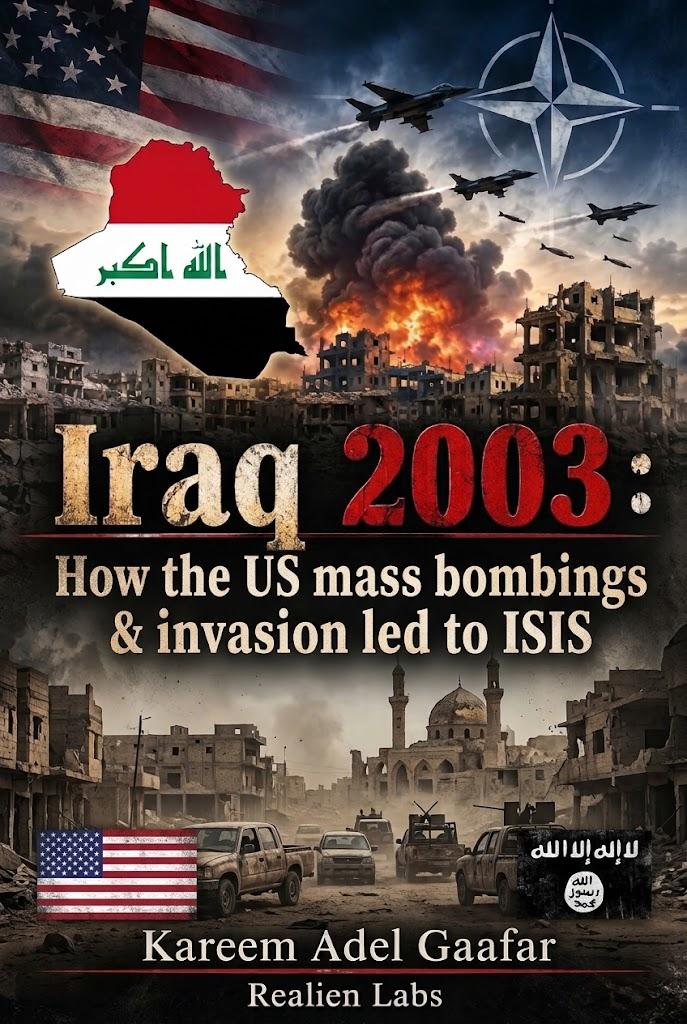
Iraq 2003 : How the US mass bombings & invasion led to ISIS
For informational and educational purposes only. Not professional advice. Users 21+ only.
Iraq 2003: How the US Mass Bombings & Invasion Led to ISIS
The question this book asks
In June 2014, a force calling itself the Islamic State took Mosul, Iraq’s second-largest city, and within days declared a caliphate across parts of Iraq and Syria. It ran slave markets, filmed executions, and committed what a United Nations commission later called genocide against the Yazidis. Most Americans saw it as something that came out of nowhere.
It did not come out of nowhere. This book follows a chain with one documented link after another, starting with a war launched in March 2003 and ending in the streets of Mosul eleven years later. The claim is not that Americans wanted ISIS. Nobody in Washington did. The claim is about outcomes and mechanics: a series of decisions, each made by identifiable people, produced the conditions out of which ISIS grew, and several of those people have since said so themselves.
That is a harder argument than “America created ISIS,” and a more defensible one. It is also an argument with real counterarguments, which this book states in its own chapter rather than hiding. The goal is a record a reader can check, not a slogan.
Link one: a war sold on weapons that did not exist
The invasion was justified publicly by the claim that Iraq held weapons of mass destruction. After the invasion, the Iraq Survey Group, led by Charles Duelfer, reported in 2004 that it had found no stockpiles of such weapons. In July 2004 the US Senate Intelligence Committee concluded that the intelligence community’s prewar judgments were overstated or unsupported, blaming faulty CIA analysis.
Britain’s own inquiry, chaired by Sir John Chilcot and published in July 2016 across 2.6 million words, reached parallel conclusions. It found that the government’s statements about Iraqi weapons had been “presented with unjustified certainty,” that policy was made on the basis of flawed intelligence that was not challenged, that Britain joined the invasion before peaceful options had been exhausted, and that there was no imminent threat from Saddam Hussein. The report stopped short of declaring the war illegal. It also found that the risks of chaos, sectarian violence and extremism had been identified before the invasion.
That last finding matters for everything that follows. This was not a case where nobody could have seen the consequences. Warnings existed, and they were set aside.
Link two: the bombing
The war opened on the night of 19–20 March 2003 with the “shock and awe” air campaign over Baghdad, followed within hours by the ground invasion. Iraq Body Count (IBC), a UK-based project that compiles civilian deaths from media and official reports, recorded more than 6,700 civilians killed in the first three weeks, between 20 March and the seizure of Baghdad on 9 April. That is a rate of roughly 320 a day for 21 days. For the first year, IBC found that at least 55 percent of civilian deaths were directly caused by US and coalition forces.
Human Rights Watch documented that thousands of Iraqi civilians were killed or injured during those three weeks, that many civilian casualties in the air war occurred during attacks aimed at senior Iraqi leaders, and that cluster munitions, especially ground-launched ones used by US and UK forces, caused hundreds of civilian casualties and left an estimated tens of thousands of unexploded submunitions behind.
Paul Rogers, a long-time analyst of the war, has argued that the scale of civilian death in those first weeks may itself have pushed many Iraqis toward armed resistance, and handed the old regime’s propagandists their message. That is an argument, not a measurement, and the book treats it as one.
Link three: the count
How many Iraqis died is contested, and this book gives ranges rather than a single number.
• Iraq Body Count documented roughly 210,000 civilian deaths from violence between 2003 and 2022. IBC counts only deaths that appear in reports it can verify, so it describes itself as a minimum.
• The Costs of War project at Brown University estimates 182,000 to 205,000 civilians killed in direct war violence.
• Survey-based estimates are higher and more disputed. The 2006 Lancet study estimated about 655,000 excess deaths with a very wide confidence interval; the Iraq Family Health Survey estimated about 151,000 violent deaths over a similar period.
Those figures differ because they measure different things. Every one of them describes a catastrophe. At its worst, in 2006, IBC recorded over 29,000 civilian deaths in a single year.
Link four: two orders
Two orders from the Coalition Provisional Authority (CPA), signed by its head, L. Paul Bremer, are the most cited turning points in the occupation. CPA Order 1, dated 16 May 2003, removed members of Saddam’s Baath Party from public life. CPA Order 2, dated 23 May 2003, dissolved the Iraqi military, security and intelligence institutions. About 400,000 Iraqi military personnel lost their jobs, according to widely cited figures; contemporary reporting put the number of soldiers and public employees affected at more than 400,000. Most soldiers were promised a termination payment, but people barred from public employment by the de-Baathification order were not eligible for those payments.
Bremer’s senior adviser Walter Slocombe favored dissolution, reasoning that the army had already disbanded itself during the invasion. Bremer obtained Defense Secretary Rumsfeld’s permission and briefed President Bush before signing. Many analysts have since called the army’s dissolution one of the war’s great strategic mistakes, because it put hundreds of thousands of armed, trained, humiliated men out of work in a country the US now occupied. Bremer himself rejects that reading, and his case is in Chapter 13.
Link five: the occupation’s conduct
Occupations are judged by how they treat the people they occupy. The record here includes Abu Ghraib, where abuse by US personnel was exposed in 2004 and later examined in Senate reports; the 2006 Mahmudiyah crimes, in which US soldiers raped and killed an Iraqi girl and killed members of her family, and for which several soldiers were convicted; and the November 2005 killings at Haditha, where US Marines killed 24 Iraqi civilians.
This book does not claim these incidents were typical of every unit, and it does not claim they alone caused the insurgency. It claims something narrower: they were documented, they were publicized across the Arab world, and they handed recruiters a story that matched the facts.
Link six: al-Qaeda arrives
Before the invasion, al-Qaeda did not control territory in Iraq. After it, a Jordanian militant named Abu Musab al-Zarqawi led a group that pledged allegiance to Osama bin Laden in late 2004 and became known as al-Qaeda in Iraq (AQI). In July 2005, al-Qaeda’s Ayman al-Zawahiri wrote to Zarqawi laying out a staged plan that began with expelling US forces from Iraq and establishing an Islamic authority there.
In April 2006, the US intelligence community’s National Intelligence Estimate on trends in terrorism, declassified that September, assessed that the Iraq conflict had become a cause for jihadists and that al-Qaeda, merged with Zarqawi’s network, was exploiting the situation in Iraq to attract new recruits and donors. US intelligence agencies, in other words, said this in a document written in 2006.
Link seven: the prison
The US ran a mass detention system in Iraq. Camp Bucca, in the south near the Kuwaiti border, held more than 100,000 detainees over its life and closed on 17 September 2009. It put Baathist officers and jihadist ideologues in the same compounds for years.
The Soufan Group, a private intelligence firm, listed nine senior Islamic State figures who had been held at Bucca, including its future leader Abu Bakr al-Baghdadi. US military records show coalition forces detained Baghdadi in Fallujah on 4 February 2004. The records place him at Camp Bucca or Abu Ghraib for roughly ten months, and a US review board recommended his release. Samir al-Khlifawi, known as Haji Bakr, a former colonel in Saddam’s army, was held at Bucca and Abu Ghraib between 2006 and 2008, and Der Spiegel reported that he became the strategist behind ISIS’s expansion into Syria.
Caution is warranted here. Where and when Baghdadi was held is murky in the records, and at least one analyst quoted by The Intercept doubts that his detention was a defining moment in ISIS’s rise. The documented part is the overlap: many of the people who later led ISIS passed through US custody. Whether Bucca created them or merely held them is argued in Chapter 13.
Link eight: the state, and its collapse
AQI and allied groups formed the Mujahideen Shura Council in January 2006 and then the Islamic State of Iraq (ISI) that October. Zarqawi was killed by US forces in June 2006. In April 2010, ISI’s two top leaders were killed in a joint US-Iraqi operation, and Baghdadi rose to lead it. In April 2013, he announced the expansion into Syria under the name Islamic State of Iraq and the Levant.
The US withdrew its troops from Iraq in December 2011. Prime Minister Nouri al-Maliki moved quickly against Sunni rivals, ordering the arrest of Sunni vice president Tariq al-Hashimi on terrorism charges that same month. Sunni protests began in Anbar in December 2012. In April 2013, security forces raided a protest camp in Hawija, and at least 50 protesters were killed according to most accounts. By the end of 2013 Anbar was in open conflict, and in January 2014 Fallujah fell to militants.
Link nine: Mosul, Speicher, Sinjar
On 10 June 2014, ISIS took Mosul after the Iraqi security forces collapsed, abandoning weapons, vehicles and a large cash haul, according to the International Crisis Group. Two days later it killed an estimated 1,700 cadets at Camp Speicher near Tikrit; the Iraqi government’s own count of missing was 1,095, and the figure is given as a range of 1,095 to 1,700. A United Nations investigative team found reasonable grounds to believe the killings were committed with genocidal intent against Shia. In August 2014, ISIS attacked Sinjar, home to the Yazidi religious minority; a UN commission of inquiry concluded in 2016 that ISIS committed genocide against them. A joint UN report in July 2015 recorded at least 15,000 civilians killed and 30,000 injured in Iraq since January 2014.
These crimes belong to ISIS and to the people who committed them. Nothing in this book transfers the guilt for them to anyone else. What it asks is a different question: how did a group like this come to have an army, a treasury and a territory?
What the officials said
The people who ran the war have gone on record.
• Barack Obama said in a March 2015 interview with Vice News that ISIL is a direct outgrowth of al-Qaeda in Iraq, which grew out of the invasion, and called it an example of “unintended consequences.”
• Tony Blair told CNN in October 2015 that there were “elements of truth” in the argument that the Iraq war helped cause the rise of ISIS. He apologized for the faulty intelligence and for mistakes in planning, but not for removing Saddam.
• David Kilcullen, a counterinsurgency adviser to US commanders in Iraq, was quoted in The Independent saying, “There would be no ISIS if we had not invaded Iraq.”
• Chilcot, speaking in 2016, said that the chaos in Iraq and the region that followed should have been foreseen.
The strongest objections
A responsible version of this argument must answer the best case against it.
First, causation is not blame for every outcome. ISIS’s roots also run through Syria’s civil war, where it grew into a state, and through Iraqi and Syrian choices that no foreign power dictated. Second, Maliki’s sectarian policies after 2011 were Iraqi decisions, and some analysts, including scholars Hal Brands and Peter Feaver, argue that different American choices, such as keeping troops in Iraq, could have prevented ISIS’s rise. Obama argued the opposite in 2016: that Iraq would not grant troops immunity, and that a continued presence would not have stopped the rise anyway. Third, Bremer has rejected the claim that his orders caused the collapse, calling the idea “simply nonsense” and pointing out that de-Baathification was narrowly drafted and that many Baathists remained in government. Fourth, Camp Bucca’s role may be overstated: many of the future leaders were extremists before they were detained.
This book takes those objections seriously. Its conclusion is the more modest one the evidence supports: the invasion was not the only cause of ISIS, but it is the necessary condition without which the later causes would have had nothing to act on, and the officials closest to the war have conceded as much.
Why it matters now
The point of tracing this chain is not to settle old arguments. A country that cannot say what its wars produced will keep starting them. The same pattern appears elsewhere in this series, in Libya in 2011, in the pipeline that recruits young people into these wars, and in the unexamined assumption that bombing and regime change are clean tools. The final chapters set out concrete lessons: demand independent intelligence review before any war, require a published plan for the day after, treat mass detention as a strategic risk, and measure a war by what it leaves behind, not by the day the statue falls.
The documented chain runs from a war based on flawed intelligence to a collapsed state and an army without jobs, from a detention system that concentrated militants to a withdrawal that left a sectarian government in charge, and from there to Mosul. The people on the receiving end of every link were Iraqi civilians.
Sources and Notes (summary)
[1] Costs of War Project, Brown University: civilian deaths in Iraq, 182,000–205,000.
[2] Iraq Body Count: “The War in Iraq: 10 Years and Counting” (19 March 2013); later totals through 2022.
[3] Human Rights Watch, “Off Target” (2003), on civilian casualties and cluster munitions.
[4] The Iraq Inquiry (Chilcot), report published 6 July 2016.
[5] US Senate Select Committee on Intelligence, Report on Prewar Intelligence Assessments (July 2004); Iraq Survey Group (Duelfer) report (2004).
[6] Coalition Provisional Authority Orders 1 (16 May 2003) and 2 (23 May 2003); Foreign Service Journal, March 2004; Al Jazeera, 24 May 2003; ADST interview with L. Paul Bremer.
[7] National Intelligence Estimate, “Trends in Global Terrorism” (April 2006), declassified key judgments.
[8] Soufan Group, November 2014, on Camp Bucca detainees; The Intercept, 25 August 2016, on US records of Baghdadi’s detention; Der Spiegel, April 2015, on Haji Bakr.
[9] International Crisis Group, 2014, on the fall of Mosul; UN OHCHR/UNAMI report, 13 July 2015; UNITAD, “Camp Speicher: A Pattern of Mass Killing and Genocidal Intent” (June 2024); UN Human Rights Council commission of inquiry on Yazidis (2016).
[10] Obama, Vice News interview (March 2015); Blair, CNN interview with Fareed Zakaria (October 2015); Kilcullen, quoted in The Independent.
[11] Cato Institute, “Was the Rise of ISIS Inevitable?” (6 June 2017), on the Brands–Feaver and Thrall–Glaser arguments.