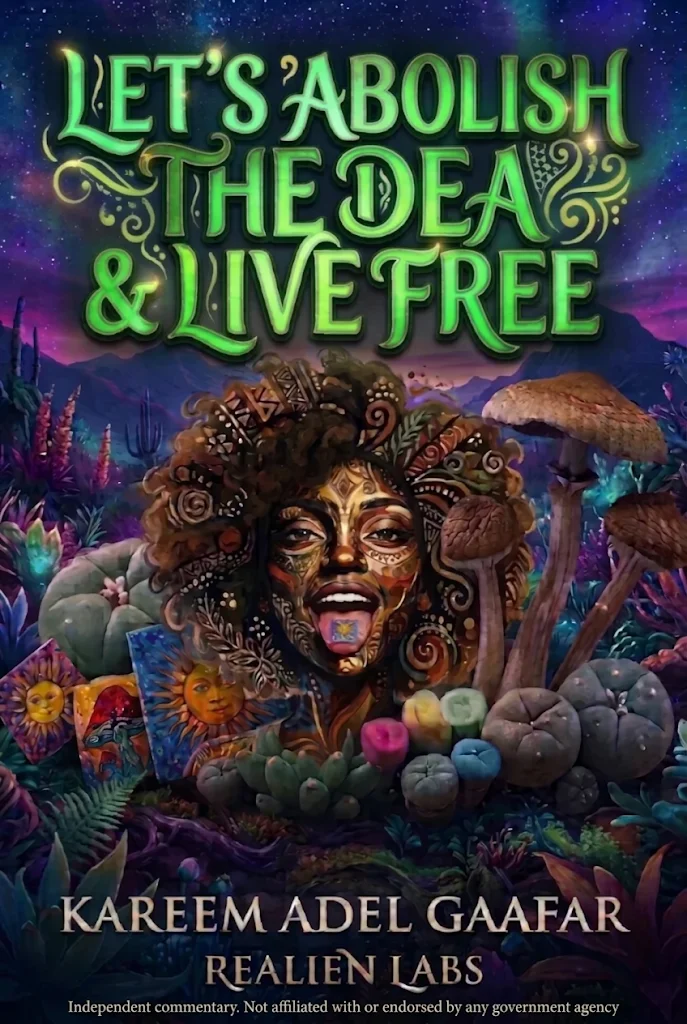
Let's abolish the DEA & Live Free
For informational and educational purposes only. Not professional advice. Users 21+ only.
A science-based, rights-respecting case for ending federal drug prohibition
Introduction
In June 2026, an Associated Press investigation reported that the U.S. Drug Enforcement Administration permitted hundreds of thousands of fentanyl pills to reach the streets of New Mexico between 2023 and 2025, according to three current and former agents and government records [1]. AP reported that agents repeatedly watched shipments they could have seized, and in some cases tracked exact pill counts, while prosecutors worked toward bigger cases [1]. A DEA special agent who filed a whistleblower complaint told AP, “We poisoned our community to make cases” [2]. The agent’s disclosures said at least 1.8 million pills were allowed to pass in one investigation [2].
The DEA disputes that account. Its spokesperson said descriptions suggesting it knowingly permitted fentanyl to reach communities are false [3], and the agency said the decisions were lawful and reasonable [2]. A former U.S. attorney told AP that prosecuting larger organizations can have a bigger impact than stopping every transaction [2]. The case for abolishing the DEA does not rest on one story. It rests on a simple question: after more than fifty years, does the enforcement-first model deliver what it promises? The agency was created on July 1, 1973 [29]. This book argues that the record, the costs and the alternatives all point the same way.
What fifty years of enforcement bought. The CDC estimates 67,798 overdose deaths in the 12 months ending March 2026, a 12.3% drop from a year earlier [4]. Deaths peaked in 2022 and have fallen three straight years, to the lowest level since 2019 [5]. The CDC points to wider access to the overdose-reversal drug naloxone, expanded addiction treatment and changes in the drug supply as possible drivers [6]. Two of those three are health measures, not arrests. The progress we are seeing comes from medicine and public health, which is exactly where this book argues the money and authority belong. In the same AP reporting, New Mexico’s overdose deaths rose 21% in a year when national deaths fell 14% [7]. That comparison does not prove cause, but it shows how a national average can hide local failure.
The benefits of abolition, in brief.
1. Money redirected to what works. The DEA’s budget was about $2.57 billion in FY2025 [8], and the President’s FY2027 request adds $362 million [9]. That is one agency. Federal drug-control spending was about $39 billion in a single recent year, and total spending since 1971 is estimated at more than $1 trillion, an estimate that varies by source and method [10]. The Cato Institute puts combined federal, state and local spending above $51 billion a year [11]. The ACLU estimated that marijuana possession arrests alone cost taxpayers at least $3.6 billion a year as of 2013 [12]. Treatment is where the gap is: SAMHSA reports that 47.2 million people needed substance use treatment in 2025 and 7.6 million received it [37]. Even a fraction of enforcement spending moved to treatment, testing and prevention would be felt first where the unmet need is largest.
2. Fewer people in cages for drugs. The Prison Policy Initiative counts about 362,000 people held for drug offenses across state prisons, local jails, federal prisons, youth and military facilities, and reports about one million drug arrests in 2020, 80% of them for possession [30]. Each of those people is a person with a family, a job or the chance of one. Ending adult-possession enforcement removes the largest source of those arrests.
3. No more taking money from people never charged. The Justice Department’s Inspector General found that the DEA seized more than $4 billion in cash from FY2007 to FY2016, 80% of all DOJ cash seizures [31]. About $3.2 billion of that was taken administratively, with no civil or criminal charges filed [32]. In the sample the Inspector General reviewed, petitions were filed in only 20% of seizures, and in 40% of those the money was fully or partly returned [32]. The Justice Department disputed parts of that report [31]. In Tampa, the DEA returned more than $43,000 it had seized from a woman at the airport after she joined a class-action lawsuit [33].
4. Constitutional rights restored. The Justice Department’s Inspector General raised concerns about the DEA’s program of “consensual encounters” with travelers at transportation hubs, and the Justice Department directed the DEA to suspend the program in a November 12, 2024 directive [13]. The Institute for Justice reports the DEA then ended it after finding it netted few arrests or drug proceeds [14]. Reporting has also described Hemisphere, a program that gave drug investigators access to AT&T call records through administrative subpoenas rather than court orders, which the government has defended as routine [15]. A 2026 GAO report on federal task forces recommended better training and misconduct guidelines [16], and AP reported that at least 17 DEA agents were charged with crimes in a decade [17].
5. An end to discriminatory enforcement. ACLU analysis of 2010 to 2018 data found that Black people were on average 3.64 times more likely than white people to be arrested for marijuana possession, even though the two groups use it at similar rates, and that law enforcement made 6.1 million marijuana arrests in that period [18]. A rule that regulates every substance by the same evidence-based standard leaves no room for that disparity to be written into enforcement. The history points the same direction. Harry Anslinger, the first commissioner of the Federal Bureau of Narcotics, which preceded the DEA, led a campaign against marijuana that Britannica describes as relying heavily on racism [19]. Some scholars caution that famous racist quotations attributed to him are unverified, so this book uses only claims it can source [19].
6. Revenue instead of cost. States with regulated adult-use cannabis markets have collected more than $28.4 billion in tax revenue since 2014, including more than $4.57 billion in 2025 alone, according to the Marijuana Policy Project, an advocacy organization [36]. A regulated market turns an enforcement expense into a tax base, and puts sales behind age checks and licensing.
7. One honest standard for every substance. Alcohol caused about 178,000 deaths a year in the United States in 2020 and 2021, according to the CDC [34], and cigarette smoking about 480,000 [35]. Both are legal and regulated through taxation, sales rules and age limits [23]. A widely cited 2010 Lancet study by David Nutt and colleagues scored 20 drugs on 16 harm criteria. It rated alcohol the most harmful drug overall (72 out of 100), ahead of heroin (55) and crack cocaine (54), and found that the results correlate poorly with the UK’s legal classification of drugs [20]. The study is British and rests on expert judgment, so it is not a verdict on U.S. law. Its lesson is about method: laws should be tested against evidence of harm, and the same standard should apply to every substance.
8. Research and medicine unblocked. Federal law defines Schedule I drugs as having a high potential for abuse and no currently accepted medical use, and that classification has long been a barrier to research [21]. Two Phase 3 trials of psilocybin for treatment-resistant depression met their main goals with modest effects, and approval would require the DEA to reschedule the drug [21]. Moving scheduling decisions to health regulators puts the decision where the evidence is.
9. Harm reduction with evidence behind it. Naloxone access is linked to lower overdose death rates [22]. Fentanyl test strips are promising but less settled: one state-level study linked their legalization to a 7% drop in overdose mortality, while a scoping review found limited evidence on overdose prevention [22]. These tools are health tools, and they work best when they are not treated as crimes.
The case this book makes. It rests on three commitments. First, science before stigma: one evidence-based standard for every substance, including alcohol and tobacco. Second, adult freedom with harm mitigation: adults decide what they put in their own bodies, and the state’s job is to make that choice safer through naloxone, drug checking and treatment. Third, children kept away from adult substances: age limits, packaging and marketing rules and potency caps, the same tools already used for alcohol and tobacco [23]. In the cannabis states studied so far, a 2024 JAMA Pediatrics study of more than 898,000 students found no net increase in adolescent cannabis use after legalization [24].
“Abolish” in this book means ending the DEA as the agency that polices adult possession and consensual sale, and moving the regulation of drugs to health and consumer-protection regulators. Violent trafficking and fentanyl smuggling would remain crimes, pursued by other federal law-enforcement agencies. That is the book’s proposal, and it is argued, not assumed.
The strongest objections, and why the book answers them. The evidence does not all point one way, and a case worth making answers its best critics. A 2024 National Academies report found regular cannabis use rose from fewer than 1 million near-daily users in 1992 to more than 17 million in 2022, and it called for federal potency standards; a committee member said the risks of psychosis, suicidal thoughts and cannabis use disorder rise as THC dose rises [25]. Researchers have also linked fully commercial, for-profit markets to more psychosis-related hospital admissions, while tightly controlled models show little change in use [26]. That is an argument for strict regulation, potency limits and age controls, not for prohibition. Portugal’s 2001 decriminalization is often described as a success: deaths fell and stayed below the EU average, but later trends partly reversed, funding mattered, and researchers caution against crediting decriminalization alone [27]. Oregon recriminalized drug possession in 2024 after public backlash to Measure 110, even though a Portland State University evaluation found little evidence the measure caused the rise in overdose deaths; an earlier study had attributed a 23% increase to it, and a later JAMA study disputed that [28]. The lesson is that design and funding matter as much as the headline, and the chapters that follow show how to get them right.
The Standard of Evidence
Every factual claim in this introduction comes from the numbered sources below. Arguments and proposals are labeled as the book’s own. Figures that rest on estimates, such as total drug-war spending, are described as estimates. Where sources disagree, both are shown. Advocacy organizations (the ACLU, Cato Institute, Marijuana Policy Project, Prison Policy Initiative and Institute for Justice) are identified as such. Arrests are not convictions. Provisional CDC counts can change.
Sources
1. Associated Press, “Staggering amounts of fentanyl hit streets as the DEA watched and took no action, records show,” June 22, 2026. https://www.nbcmiami.com/news/national-international/dea-allowed-fentanyl-hit-streets-without-acting/3823985/ and https://www.nbcwashington.com/news/national-international/dea-allowed-fentanyl-hit-streets-without-acting/4119780/
2. Same AP story (Howell whistleblower quote, 1.8 million pills, DEA statement, former U.S. attorney). https://www.nbcconnecticut.com/news/national-international/dea-allowed-fentanyl-hit-streets-without-acting/3747496/
3. Same AP story (DEA spokesperson statement). https://www.nbcboston.com/news/national-international/dea-allowed-fentanyl-hit-streets-without-acting/3969002/
4. CDC, “CDC Launches New Overdose Prevention Data Channel,” Aug. 31, 2026. https://cdc.gov/media/releases/2026/cdc-launches-new-overdose-prevention-data-channel.html
5. AJMC, “Drug overdoses drop by 14% in 2025 compared with previous year.” https://www.ajmc.com/view/drug-overdoses-drop-by-14-in-2025-compared-with-previous-year
6. Axios, “U.S. overdose deaths drop 12%, per CDC estimates,” Nov. 3, 2026. https://axios.com/2026/11/03/overdose-deaths-falling-cdc
7. Same AP story (New Mexico +21% versus national -14%). https://www.nbcdfw.com/news/national-international/dea-allowed-fentanyl-hit-streets-without-acting/4039379/
8. Bloomberg Government, “FBI, DEA Targeted for Broad Funding Cuts in Trump Proposal.” https://news.bgov.com/payroll/trump-seeks-nearly-8-budget-cut-for-justice-department
9. DEA Administrator Terrance Cole, testimony on the FY2027 budget request, Senate Appropriations. https://www.appropriations.senate.gov/imo/media/doc/cole_testimony_fy271.pdf
10. NBC News, “Costs of the war on drugs continue to soar.” https://www.nbcnews.com/meet-the-press/data-download/costs-war-drugs-continue-soar-rcna92032
11. Gigafact, “Does the war on drugs cost U.S. taxpayers tens of billions of dollars a year?” (Cato Institute, 2017). https://gigafact.org/fact-briefs/does-war-drugs-cost-us-taxpayers-tens-billions-dollars-year
12. The Nation, “The Scandal of Racist Marijuana Arrests” (citing the ACLU, 2013). https://www.thenation.com/?p=88776
13. DOJ Office of the Inspector General, “Notification of Concerns Identified in the DEA’s Transportation Facilities Interdiction Program,” 25-005. https://oig.justice.gov/sites/default/files/reports/25-005_3.pdf
14. Institute for Justice, “DEA Ends Transportation Interdiction Program.” https://ij.org/press-release/dea-ends-transportation-interdiction-program-after-watchdog-report-triggered-by-footage-showing-agents-threatening-abusing-innocent-traveler/
15. The Intercept, “DEA Hemisphere phone data collection surveillance,” March 18, 2025, and ABC News, Sept. 2013. https://theintercept.com/2025/03/18/dea-hemisphere-phone-data-collection-surveillance/ and https://abcnews.go.com/blogs/headlines/2013/09/dea-program-puts-phone-company-inside-government-offices
16. U.S. Government Accountability Office, GAO-26-108468. https://www.gao.gov/assets/gao-26-108468.pdf
17. U.S. News (AP), “Former DEA agent sentenced to 5 years,” Jan. 21, 2026. https://www.usnews.com/news/best-states/new-york/articles/2026-01-21/former-dea-agent-sentenced-to-5-years-in-prison-for-using-badge-to-protect-drug-trafficking-friends
18. ACLU, “A Tale of Two Countries: Racially Targeted Arrests in the Era of Marijuana Reform.” https://www.aclu.org/publications/tale-two-countries-racially-targeted-arrests-era-marijuana-reform
19. Britannica, “Why is marijuana illegal in the U.S.?”; CBS News, “Harry Anslinger: the man behind the marijuana ban”; Boston University Law Review (Fisher, 2021). https://britannica.com/story/why-is-marijuana-illegal-in-the-us and https://www.cbsnews.com/news/harry-anslinger-the-man-behind-the-marijuana-ban and https://www.bu.edu/bulawreview/files/2021/07/FISHER.pdf
20. Nutt, King and Phillips, “Drug harms in the UK: a multicriteria decision analysis,” The Lancet, 2010. https://api.core.ac.uk/oai/oai:eprints.lse.ac.uk:30076 and https://www.sciencedaily.com/releases/2010/11/101101162138.htm
21. American Bar Association, Administrative Law Review (2024), on Schedule I and psychedelic research; Drug Discovery & Development, psilocybin Phase 3 results. https://www.americanbar.org/groups/administrative_law/resources/administrative-law-review/2024-summer/fdas-role-push-scheduling-reform-expand-research-psychedelic-medicines and https://www.drugdiscoverytrends.com/what-if-psilocybin-works-about-as-well-for-depression-as-an-ssri/; BioSpace, on DEA rescheduling needed for approval. https://www.biospace.com/drug-development/psychedelics-space-at-a-tipping-point-as-compass-definium-gear-up-to-file-for-approval
22. Harvard Gazette, “Drug overdose deaths remain high. Fentanyl test strips may help”; Bhai, McMichael and Mitchell (2025); Kutscher et al., “Fentanyl Test Strips for Harm Reduction: A Scoping Review.” https://news.harvard.edu/gazette/story/2024/01/drug-overdose-deaths-remain-high-fentanyl-test-strips-may-help, https://www.citedrive.com/en/discovery/impact-of-fentanyl-test-strips-as-harm-reduction-for-drug-related-mortality and https://pmc.ncbi.nlm.nih.gov/articles/pmid/38829042
23. Nutt, King and Phillips (2010), introduction (alcohol and tobacco regulated by taxation, sales and age restrictions). https://www.Gwern.net/doc/statistics/decision/2010-nutt.pdf
24. Boston College, “BC researchers explore effect of cannabis legislation on teen substance abuse” (JAMA Pediatrics, 2024); NORML summary of sample size. https://bc.edu/bc-web/sites/bc-news/articles/2024/spring/study-explores-cannabis-legislation-effect-on-substance-abuse.html and https://norml.org/blog/2024/04/15/jama-pediatrics-legalization-laws-linked-with-fewer-teens-using-marijuana-other-intoxicants/
25. WFAE/NPR, “5 things to know from this week’s big report on cannabis” (National Academies, 2024). https://www.wfae.org/2024-09-28/5-things-to-know-from-this-weeks-big-report-on-cannabis
26. Neuroscience News, on cannabis legalization models, psychosis and addiction. https://neurosciencenews.com/legalized-cannabis-addiction-psychosis-30920/
27. Transform Drug Policy Foundation, “Drug decriminalisation in Portugal: setting the record straight”; UNSW Social Policy Research Centre (2024); The Incidental Economist. https://transformdrugs.org/drug-decriminalisation-in-portugal-setting-the-record-straight/, https://unsw.edu.au/content/dam/pdfs/ada/sprc/research-reports/dpmp-drug-summit-2024-explainers/2024-11-was-decriminalisation-effective-in-portugal-v3.pdf and https://theincidentaleconomist.com/wordpress/drug-decriminalization-and-harm-reduction-in-portugal-a-review-of-the-evidence/
28. Portland State University, final report on Measure 110; Healthy Debate on the JAMA study and Oregon’s House Bill 4002. https://www.pdx.edu/news/psu-researchers-release-final-report-landmark-project-exploring-impacts-measure-110 and https://healthydebate.ca/?p=37885
29. U.S. Drug Enforcement Administration, “DEA Celebrates 50 Years” (creation of the DEA, July 1, 1973, under Reorganization Plan No. 2). https://www.dea.gov/dea-celebrates-50-years
30. Prison Policy Initiative, “Mass Incarceration: The Whole Pie 2025” and accompanying drug-offense graph (362,000 people held for drug offenses across state prisons, local jails, federal, youth and military facilities); Prison Legal News summary of the 2024 edition (about one million drug arrests in 2020, 80% for possession). Prison Policy Initiative is an advocacy organization. https://www.prisonpolicy.org/reports/pie2025.html, https://www.prisonpolicy.org/graphs/pie2025_drugs.html and https://prisonlegalnews.org/news/2024/nov/15/ppi-releases-10th-anniversary-report-mass-incarceration-us
31. DOJ Office of the Inspector General, “Review of the Department’s Oversight of Cash Seizure and Forfeiture Activities” (2017): DEA cash seizures of more than $4 billion in FY2007 to FY2016, 80 percent of DOJ’s total; the Justice Department disputed parts of the report. https://oig.justice.gov/news/doj-oig-releases-report-dojs-oversight-cash-seizure-and-forfeiture-activities and https://oig.justice.gov/node/975
32. American Bar Association Journal, “DEA has seized more than $3B over 10 years from people never charged with crimes, report says”; Reason, “DEA Seized $4 Billion From People Since 2007. Most Were Never Charged with a Crime” (petitions filed in 20 percent of reviewed seizures; 40 percent of those saw money fully or partly returned). https://www.abajournal.com/news/article/dea_has_seized_more_than_3b_over_10_years_from_people_never_charged_with_cr and https://reason.com/2017/03/29/the-dea-seized-4-billion-from-people-sin/
33. Institute for Justice, class-action lawsuit on behalf of air travelers whose cash was seized by the DEA; Reason, “DEA to Return $43,000 It Seized From Tampa Woman at Airport.” https://ij.org/inspector-general-report-dea-seized-3-2-billion-cash-without-judicial-oversight/ and https://reason.com/?p=8093702
34. CDC, “Alcohol Use and Your Health: Facts and Stats” (about 178,000 deaths per year from excessive alcohol use, 2020 to 2021; Esser et al., MMWR 2024). https://www.cdc.gov/alcohol/facts-stats/index.html
35. Gigafact, citing CDC, on annual U.S. deaths from cigarette smoking (about 480,000) and alcohol (about 178,000). https://gigafact.org/?p=8424
36. Marijuana Policy Project, “States Surpass $28 Billion in Tax Revenue From Legal Adult-Use Cannabis Sales,” June 18, 2026 (over $28.4 billion since 2014; over $4.57 billion in 2025; excludes medical cannabis). MPP is an advocacy organization. https://www.mpp.org/news/press/states-surpass-$28-billion-in-tax-revenue-from-legal-adult-use-cannabis-sales/
37. SAMHSA, “SAMHSA Releases Annual National Survey on Drug Use and Health,” July 27, 2026 (2025 survey: 47.2 million people needed substance use treatment; 7.6 million received it). https://www.samhsa.gov/newsroom/press-announcements/20260727/samhsa-releases-annual-national-survey-on-drug-use-and-health