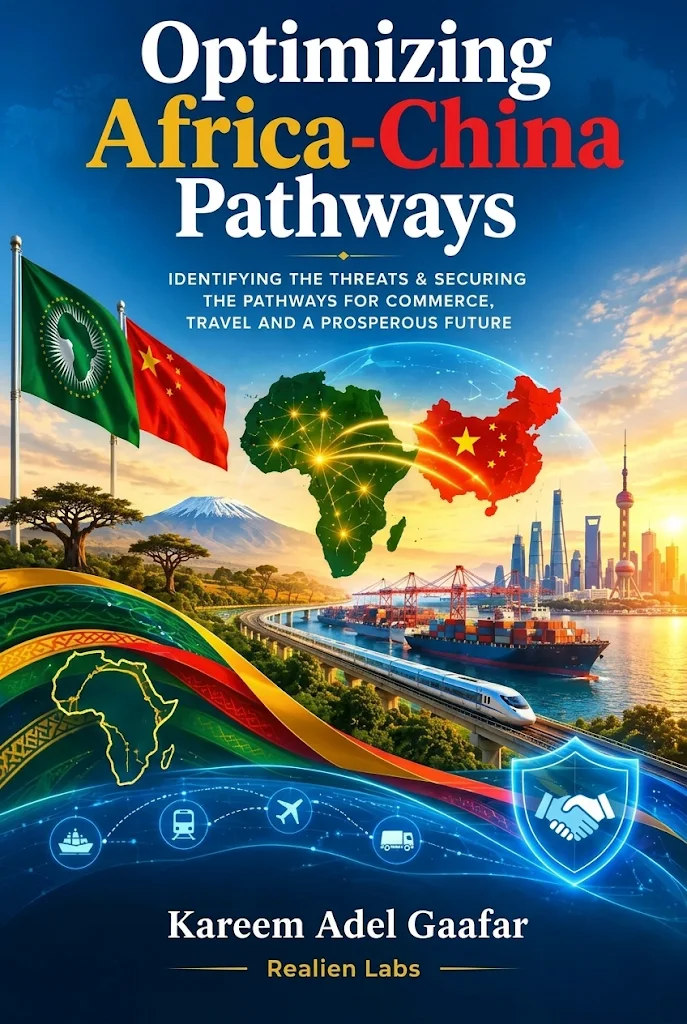
Optimizing Africa-China Pathways
For informational and educational purposes only. Not professional advice. Users 21+ only.
The traffic between Africa and China is already enormous. Total trade between China and Africa reached a record US$348.05bn in 2025, up 17.7% on the year, while Africa’s trade deficit with China grew 64.5% to US$102.01bn. [1] China has been Africa’s largest trading partner for 16 consecutive years. [2] And the door is opening wider: China announced zero-tariff treatment for all African countries it has diplomatic ties with, starting May 1, 2026. [3]
But the pathways that carry all this have not kept pace. A pathway can be secure and still be slow, expensive and confusing, and that is a failure too. This book is about both halves: finding the threats and securing the routes, and then optimizing them so that a seller, a buyer, a student or a translator can move from Africa to China, or China to Africa, without drowning in paperwork. The picture I want is simple. You say, “I want to ship this from here to there,” and ten quotes appear. Ten train options, ten flights, the visa steps and the costs, all in one place, accessible to everyone.
What counts as a pathway. Anything that carries people, goods, information or money between the two. That means:
• Air: passenger and cargo flights. Ethiopian Airlines is the largest airline in the direct China-Africa market, but only about 17.9% of passengers travel on direct flights. [4] Demand is there, and so is the gap. Ethiopian increased its weekly Guangzhou flights from seven to ten in 2023. [5]
• Sea and rivers: ports, container ships and inland waterways. When shipping is forced off the Red Sea route, going around the Cape of Good Hope adds around 3,500 nautical miles and 10 to 12 days to each trip. [6] That figure is for Asia-Europe voyages, but it shows how one chokepoint can add weeks to a supply chain.
• Land: rail, roads and corridors. The Mombasa-Nairobi railway cut a trip that used to take up to ten hours to five or six. [7] But the same railway shows the other side. An order to move all Mombasa cargo by rail in order to make the line profitable led to court challenges, unemployment and protests among truckers. [8] Optimizing a pathway means giving users a better option, not forcing them onto one.
• Digital: fiber, satellite and wireless internet. Submarine cable cuts are not uncommon, with over 100 each year on average. [9] In March 2024, damage to four cables off West Africa disrupted internet service in eight countries. [10] Two more cables, SEACOM and EASSy, were damaged in May 2024, with a dragging ship anchor suspected, and repairs took about three weeks. [11] One cable is not a pathway, and a network needs routes it can fall back on.
• Money: SWIFT, CIPS and African systems. Seven Russian banks were banned from SWIFT in March 2022 [12], which showed how a payment pathway can be switched off by political decision. China’s own system has limits too: CIPS still largely relies on SWIFT for payments that do not involve domestic banks. [13] On the African side, PAPSS launched for commercial use on January 13, 2022, with instant payment, pre-funding and net settlement as its core functions. [14] Its chief executive said in September 2026 that he expects it to connect to payment networks in China, India and Brazil in the first quarter of 2027. [15] That is a plan, not a finished link, and analysts have noted that African payment initiatives face their own hurdles. [16] The book maps how these systems can work together so that a trader is not dependent on any single one.
The threats. The routes cross some of the most dangerous places on the map. Africa is described as the global epicentre of terrorist attacks, with groups across the Sahel, the Lake Chad Basin, the Great Lakes region, Mozambique and the Horn of Africa that are affiliates of the Islamic State or Al-Qaeda networks. [17] Six of the ten countries most affected by terrorism are in sub-Saharan Africa. [18] Kidnapping is a separate risk for travelers and workers: five Chinese nationals were kidnapped at a gold mine in eastern Congo in November 2021 [19], though one analyst noted that no studies measure the frequency of attacks on Chinese personnel in Africa, so the rise is anecdotal. [20] This book also covers violence from other sources, including mass shootings, bombings and military action, as well as natural disasters, because a pathway has to be safe for the people on it, and those people need hubs of safe shelter along the way.
The people pathway. Visas are a pathway too, and right now they are a bottleneck. A list of 50 countries whose citizens can visit China visa-free for 30 days, published in 2026, included no African country. [21] The 240-hour visa-free transit policy covers 55 countries and leaves the entire continent off its list. [22] Africa has been moving in the other direction on its own side: Togo announced in May 2026 visa-free access for all African passport holders. [23] Students, translators, private businesses and researchers all need an easier road, and the book looks at what can be done.
Starting small, and starting fast. The same ease has to reach the smallest builders. A visa application, a company registration, a business account, a contract between two firms in two countries: for a large company these are routine, with staff and lawyers to handle them. For a small business owner or a solo software developer, each one can take time and energy that should go into the product. Software is the clearest case, because it needs little more than skill, a laptop and a connection, and it can be built in one country and sold in another without a shipment. The book argues that the paperwork around it should be as light as the product. It proposes one place where an innovator can see which visa fits their purpose and what it needs, what it takes to set up a business or a partnership, and how to get paid across the border, with every step explained in plain language and every cost shown up front. The goal is simple: fast and good, for the small founder as much as for the large firm.
The case this book makes. It is the author’s argument, not settled fact: that the Africa-China relationship will be stronger and fairer if the routes between them are fast, cheap, simple and safe, and if African businesses can use those routes as easily as anyone else. Chinese exports to Africa are mostly machinery, electronics and solar equipment, while Africa’s exports to China are dominated by raw materials such as crude oil, copper, cobalt and iron ore. [24] Better pathways would let African producers, not only African buyers, use them. Critics raise real concerns about that relationship, including debt and trade imbalance, and the chapters on land and money cover them as well.
The Standard of Evidence
Every factual claim in this introduction comes from the numbered sources below. Trade figures come from Chinese customs data as reported by news and research outlets, and Chinese state media is identified as such. The visa-list claims come from Nigerian and Ghanaian news reports of Chinese government lists, and they can change, so check the current official lists before relying on them. The PAPSS connection to China is a stated plan, not a completed link. Terrorism figures differ between sources, which use different definitions and periods, so the book gives each with its source. Kidnapping risk is described by one analyst as anecdotal. The case for optimizing the pathways, the picture of instant quotes and simple paperwork, and the proposal for small founders and software builders are the author’s own arguments and vision, not findings.
Sources
1. NTU Centre for Asian Studies, “China-Africa trade hits record US$348bn as deficit balloons” (Jan. 30, 2026). https://www.ntu.edu.sg/cas/news-events/news/detail/china-africa-trade-hits-record-us-348bn-as-deficit-balloons
2. bne IntelliNews, “China-Africa trade soars 12.4% in first five months of 2025” (June 11, 2025). https://www.intellinews.com/china-africa-trade-soars-12-4-in-first-five-months-of-2025-385489/
3. Xinhua via english.www.gov.cn, “China to grant zero-tariff treatment to all African countries with diplomatic ties” (Apr. 28, 2026). https://english.www.gov.cn/news/202604/28/content_WS69f0a1d7c6d00ca5f9a0aad0.html
4. Airport.online, “China Southern Addis Ababa flights.” https://airport.online/baiyun-airport/en/china-southern-addis-ababa-flights
5. Fana Broadcasting Corporate, “Ethiopian Airlines announces three additional weekly flights to China’s Guangzhou” (Sept. 26, 2023). https://www.fanabc.com/english/?p=51518
6. Imperial College Business School, “Red Sea crisis: What it takes to reroute the world’s biggest cargo ships.” https://imperial.ac.uk/business-school/news/bbc-future-quotes-professor-eddie-anderson-houthi-missile-strikes-the-red-sea
7. Voice of America, “China’s BRI Brings Roads, Rails and Debt to Africa.” https://www.voanews.com/a/china-s-bri-brings-roads-rails-and-debt-to-africa/7306133.html
8. ADF Magazine, “Details of Kenyan railway loan show lopsided relationship with Chinese lenders” (Dec. 2022). https://adf-magazine.com/2022/12/details-of-kenyan-railway-loan-show-lopsided-relationship-with-chinese-lenders/
9. Internet Society Pulse, “What can we learn from Africa’s multiple submarine cable outages?” https://pulse.internetsociety.org/blog/what-can-we-learn-from-africas-multiple-submarine-cable-outages/
10. Bloomberg via Data Center Knowledge, “Undersea Cable Damage Causes Internet Outages Across Africa” (Mar. 15, 2024). https://www.datacenterknowledge.com/networks/undersea-cable-damage-causes-internet-outages-across-africa
11. Internet Society, on the May 2024 SEACOM and EASSy cable damage. https://www.internetsociety.org/?p=212483
12. DLA Piper, “SWIFT and the Ukraine conflict: Latest developments” (May 3, 2022). https://www.dlapiper.com/en/insights/publications/global-sanctions-alert/2022/explaining-swift-and-recent-actions
13. Carnegie Endowment, “How Sanctions on Russia Will Alter Global Payments Flows” (Mar. 2022). https://carnegieendowment.org/china/posts/2022/03/how-sanctions-on-russia-will-alter-global-payments-flows
14. Carnegie Endowment, “Latest Milestone for the African Continental Free Trade Area: PAPSS” (Feb. 2022). https://carnegieendowment.org/posts/2022/02/latest-milestone-for-the-african-continental-free-trade-area-the-pan-african-payment-and-settlement-system?lang=en
15. The Rio Times, “PAPSS, Afreximbank China India payment links 2027.” https://www.riotimesonline.com/papss-afreximbank-china-india-payment-links-2027/
16. South African Institute of International Affairs, “International Payments, BRICS and Africa,” Occasional Paper 360 (Oct. 2024). https://saiia.org.za/wp-content/uploads/2024/10/SAIIA_OP-360_InternationalPaymentsBRICSAfrica.pdf
17. S. Rajaratnam School of International Studies, “Africa” (counter-terrorism trends). https://rsis.edu.sg/ctta-newsarticle/africa-2/
18. ASIS Security Management, “Terrorism Dropped in 2025” (Mar. 2026). https://www.asisonline.org/security-management-magazine/latest-news/today-in-security/2026/march/Terrorism-Dropped-in-2025/
19. Peterson Institute for International Economics, “Chinese nationals have become targets of violence as China deepens its engagement in Africa” (2022). https://www.piie.com/blogs/realtime-economics/2022/chinese-nationals-have-become-targets-violence-china-deepens-its
20. Business & Human Rights Resource Centre, “Africa: Chinese workers’ safety under threat as number of attacks on them is reportedly on the rise.” https://www.business-humanrights.org/ko/최신-뉴스/africa-chinese-workers-safety-under-threat-as-number-of-attacks-on-them-is-reportedly-on-the-rise
21. Legit.ng, “China Releases Full List of 50 Countries Whose Citizens Can Visit Visa-Free for 30 Days” (2026). https://www.legit.ng/people/1732857-china-releases-list-countries-eligible-30-day-visa-free-transit-policy/
22. Legit.ng, “China Releases Full List of 55 Countries Eligible for 240-Hour Visa-Free Transit” (2026). https://www.legit.ng/people/1732844-china-releases-list-countries-eligible-240-hour-visa-free-transit/
23. China Daily, on Togo’s visa-free access for African passport holders (June 5, 2026). https://www.chinadaily.com.cn/a/202606/05/WS6a223878a310d6866eb4ca1e.html
24. Khusoko, “China-Africa trade hits $222 billion amid tariff shift” (Oct. 1, 2025). https://khusoko.com/2025/10/01/china-africa-trade-hits-222-billion-amid-tariff-shift/