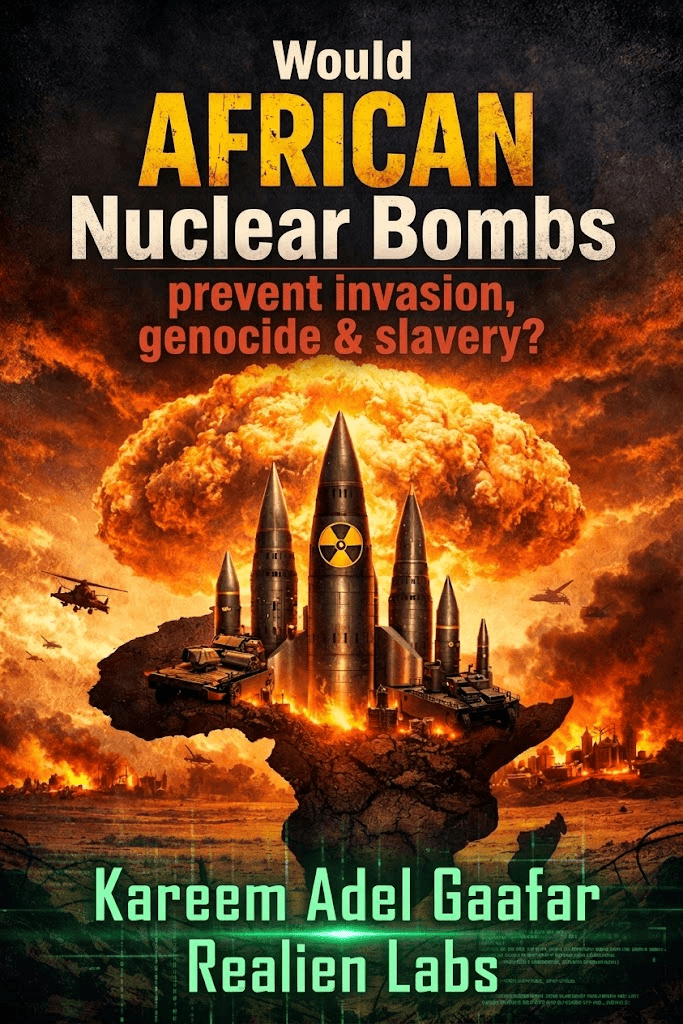
Would African Nuclear Bombs prevent invasion, genocide & slavery
For informational and educational purposes only. Not professional advice. Users 21+ only.
History does not repeat because humans forget. It repeats because incentives remain unchanged. For over a millennium, Africa has suffered invasions, genocides, slavery (IGS), exploitation and the loss of lives, autonomy and futures that never had the chance to exist.
Africa’s suffering is not a mystery. It is not the result of ignorance, misunderstanding, or historical accident. It is the predictable outcome of a world in which the destruction of African lives has rarely imposed existential consequences on those responsible. Invasions, slavery, and genocide did not persist for over a millennium because they were misunderstood, but because they were profitable.
What stops genocide? What prevents invasion? What makes slavery impossible rather than illegal?
History and modern times offer a blunt answer: Laws and treaties were paper and ink, now many are data stored on drives in a server, neither paper nor storage drives can stop evil.
Evil is also certainly not stopped by appeals to reason, morality or conscience, after all, if these evil people who did and continue to do these things were reasonable, had any morality or conscience, they wouldn’t be doing this evil in the first place.
1.5 billion Africans alive today should not depend on papers, storage drives and the “good will” of evil that can inflict IGS on Africans, as their protection from IGS and all the horrors associated with it.
If other methods could prevent IGS, why haven’t they ? Laws and treaties did not prevent them, conventional African weapons and military forces did not prevent them and hoping that every country with the capacity to inflict IGS on Africa has good will and won’t commit these acts again is not rational to protect the lives of 1.5 billion Africans.
So what’s left to discuss as a defense against IGS to protect Africa ? Nuclear Weapons.
This book mainly focuses on asking and answering one question:
Would African nuclear weapons prevent invasion, genocide, and slavery (IGS)?
What this book is not:
It does not ask whether nuclear weapons are good. It does not argue morality, legality, or ethics. It does not advocate violence, escalation, or war. It does not claim nuclear weapons solve Africa’s internal political, economic, or social problems. It does not propose that nuclear weapons prevent internal repression, civil war, or domestic atrocities. States cannot deter themselves.
If you are looking for reassurance, idealism, or ethical comfort, this is not that book.
What this book is:
It examines historical patterns of external invasion, genocide, and enslavement imposed on Africa through land, naval, and air power, including occupation, coercion, proxy violence, and resource extraction. The focus is on what was done, how it was done, and why it was repeatedly possible.
It explains, at a functional level, how conventional and nuclear weapons actually work and how those capabilities have shaped intervention decisions involving Africa. The emphasis is on effects and constraints, not theory or abstraction.
It evaluates current and potential IGS threats based on demonstrated behavior, existing military systems, and strategic incentives rather than stated intentions or public rhetoric. This includes actors actively harming Africa, actors harming others, and actors with the capacity to do both.
It then examines Africa’s existing defenses against IGS, including military forces, diplomacy, and institutional mechanisms, and why these defenses have historically failed to impose decisive costs on external aggressors.
The book analyzes how African nuclear deterrence could emerge through indigenous development, shared arrangements, or external defensive guarantees, and it assesses the likely reactions such a shift would trigger, including economic pressure, sanctions, and military responses, particularly from Western powers.
Finally, the book answers its central question directly. It identifies what African nuclear weapons would likely prevent, what they would only reduce the probability of, what they would fail to stop, and what risks and harms they would introduce.
The conclusion does not offer a perfect solution. It weighs trade-offs, constraints, and damage, and then evaluates the least catastrophic option available in the world as it exists rather than the world as it should be.
This book is not about ideals. It is about consequences and saving as many lives as possible.
The Standard of Judgment
This book does not ask whether nuclear weapons create a just, moral, or ideal world. It does not measure success by legality, international approval, ethical satisfaction, or abstract notions of peace. Those standards are not how the world has historically judged Africa’s survival, and they are not how external power has operated when Africa was invaded, partitioned, enslaved, or destroyed.
The standard used here is outcome.
The central question is whether, in the world as it actually functions rather than the world as it is described, the absence of nuclear deterrence has imposed disproportionate, repeated, and catastrophic costs on Africa. The analysis asks whether Africa’s lack of ultimate deterrent capacity has made invasion, coercion, regime destruction, and mass death structurally easier than it would have been under different cost conditions.
This book assumes no benevolence. It does not assume restraint, goodwill, or moral learning. It assumes that states act when the expected benefits of action outweigh the expected costs, and that restraint emerges primarily when those costs become unacceptable. This is not a cynical assumption. It is the historical baseline.
Under this standard, intentions are irrelevant. Justifications are irrelevant. Public rhetoric, humanitarian language, and legal framing are treated as noise unless they demonstrably constrain action. What matters is whether violence occurred, whether it was attempted, and whether it was abandoned once the expected cost rose high enough.
The question, then, is not whether nuclear weapons would prevent all harm. No system does. The question is whether their absence has made the most extreme forms of external harm more likely, more frequent, and more devastating when directed at Africa than when directed elsewhere.
Africa is not treated as an exception, African cases are weighed against non-African cases in which nuclear deterrence existed and where similar actions were avoided, delayed or abandoned.
This book does not require certainty. It does not demand proof that nuclear weapons would have prevented every invasion or atrocity. That standard would be dishonest. Instead, it asks whether the probability distribution of catastrophic outcomes would plausibly shift under different deterrence conditions, and whether that shift would be large enough to matter at the scale of continents and generations.
The standard is also asymmetric. The cost of being wrong is not evenly distributed. If nuclear deterrence is unnecessary and absent, the cost is minimal. If it is necessary and absent, the cost is measured in mass death, lost sovereignty, destroyed futures, and generations erased. This asymmetry matters, and pretending otherwise is itself a moral choice.
This book therefore rejects perfection as a benchmark. It seeks to identify whether there exists a class of capability that historically alters external behavior enough to reduce exposure to the worst outcomes, even if it introduces new risks of its own.
The final judgment is not whether nuclear weapons are good. The judgment is whether their continued absence leaves Africa exposed to a pattern of harm that history suggests will otherwise repeat.