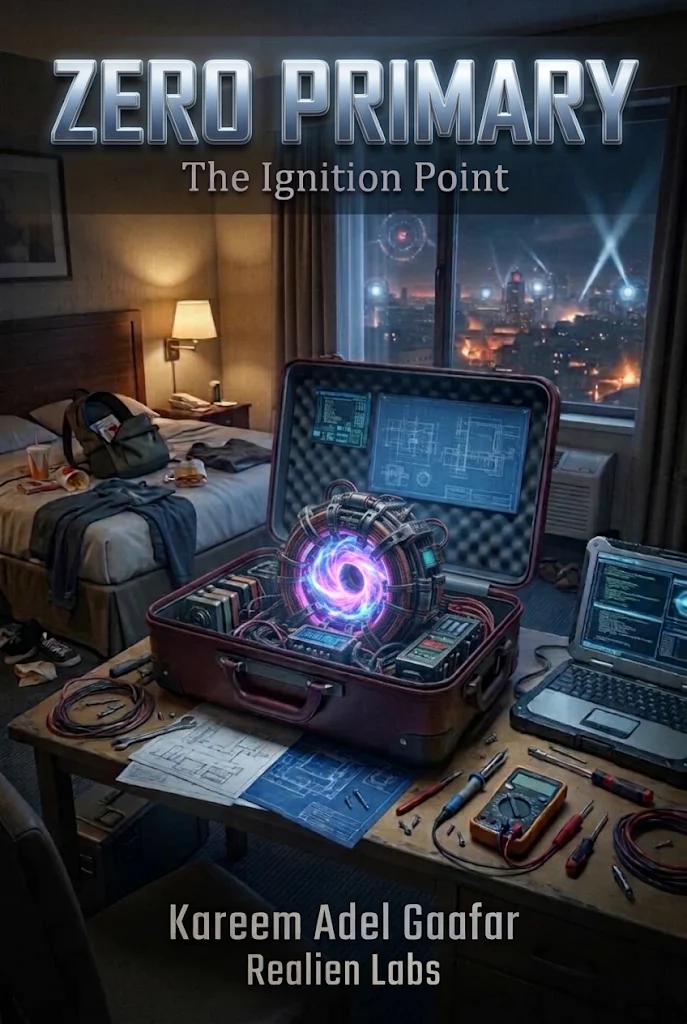
Zero Primary
For informational and educational purposes only. Not professional advice. Users 21+ only.
He is an engineer, not a theorist, and he is the kind of person who distrusts an idea until he has held it in his hands. That habit is what makes him dangerous. He is not looking for a weapon. He is working on something else when a realization arrives, quietly and without ceremony, that a thing the world has long treated as unfinished might be possible after all.
The title names it. In a conventional thermonuclear weapon, the mechanical shock of an ordinary fission bomb is used to compress the fusion fuel. That fission stage is the primary. A zero primary is a fusion weapon with no fission stage at all. The idea is not new, and it is not a secret. Analysts have long described pure fusion weapons as a dream for nuclear weapons designers. One 1998 arms-control report concluded that their scientific feasibility had not yet been established, and warned that they would be far more dangerous for proliferation, because getting highly enriched uranium or plutonium is currently the main obstacle. Arms-control groups were already worried, in public, that stockpile research could open a route to such weapons. The danger the novel dramatizes is that the obstacle everyone relies on might one day not be there.
He becomes obsessed, in the ordinary way obsession arrives: first as curiosity, then as a late-night habit, then as the only thing he can think about. He sketches, calculates and checks. And then, because he is an engineer, he builds. The novel does not ask the reader to believe that this could be done, and it never explains how. It asks what a person does once he believes that it has been. The device sits in a rented room, in a case on a table, under a lamp, beside a laptop and a stack of plans. Outside the window, the city goes about its night.
Then comes the question that the rest of the book cannot escape. He does not know what to do with it. There are four doors, and he walks up to each in turn.
He can share the knowledge. Some part of him believes that a secret like this belongs to everyone, and that hiding it only guarantees that the wrong person finds it first. But the history of this exact question is not reassuring. Under the Atomic Energy Act, information about the design and manufacture of atomic weapons is “born secret,” classified from the moment it exists. In 1979 the government tried to stop a magazine from publishing an account of the H-bomb. The case was eventually dropped, because the information had already been published elsewhere. Once an idea exists in more than one head, no law can contain it.
He can destroy the knowledge. He can burn the notes, wipe the drives and forget what he has learned. But a mind cannot be wiped, and an idea that occurred to one person has a way of occurring to another.
He can destroy the device. He can take it apart and bury it. But what was built can be reconstructed, and investigators will try. Nuclear attribution is the process of tracing the origin of what was used. It combines forensic analysis, an understanding of how such weapons are developed and information from intelligence and law enforcement. Whatever he leaves behind, someone will put it together and work out what it was.
Or he can detonate it. That door needs no explanation, and it is the one the book will not let him walk through lightly.
Each choice looks like an ending, and each one is only a route. Zero Primary is fiction. It is a tense, intimate thriller about one person, one room and one decision that refuses to stay private. It is about a man who learns that the safest answer was never available, and that however he turns, the road leads to the same place.
All routes lead to the ignition point.